
(Perfunctory business note: Yes, it’s been over three years since I last made a post to this blog. No, I don’t know if regular posting (as if it ever was) will resume. Life has changed…from a selfish personal perspective, mostly for the better, even if the rest of the world is on shaky footing. That’s all I’m going to say about it before getting down to the business of (as one of the subjects of this post would say) The Work.)
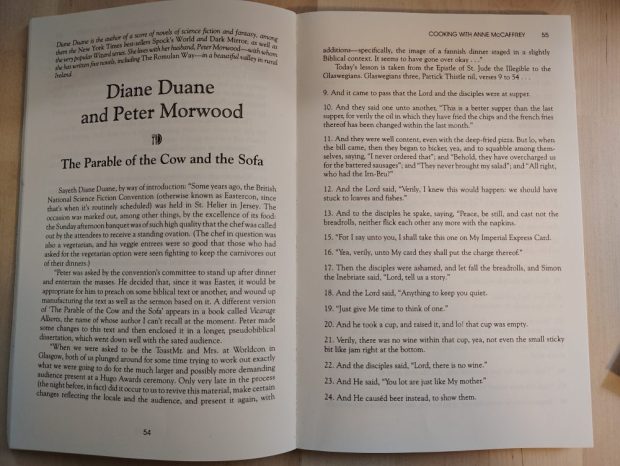
I wasn’t going to write one of these posts about Diane and Peter. As much as I love them, as much as they were very much an inspiration for attempting this project, it was with some disappointment on buying this book, knowing they had contributed to it, that their entry, while amusing, was not an actual recipe.
But Peter Morwood suddenly and unexpectedly died on May 9th, 2025. I want to do something.
With embarrassment, I must admit that while Diane Duane’s books are at the top of my all-time favorites, Peter’s books have been sitting in my TBR pile for ages. (My drive to read any fiction at all has been extremely diminished the last several years; I’ve been reading more nonfiction, I’ve been listening to podcasts, I’ve been watching probably way too much YouTube, and I’ve been poking around the edges of narrative-focused games for quasi-professional reasons as well as personal interests.) I still want to fix that deficit at some point, but under the circumstances, I don’t want to make motivating myself to read a condition of writing this. Breaking from the format of this series, I’m not here to write a book review…I’m here to write an eulogy.
It’s not that I’ve never read Peter’s work. It’s that nearly all that I’ve read of his has been through his posts on Tumblr. I joined Tumblr to follow Diane Duane’s posts because my metric for subscribing to blogs and feeds is primarily whether they post stuff I enjoy reading and is relevant to my interests. Naturally, given DD’s tendency to reblog her husband’s writing, Peter became the second person I followed. Peter wrote a lot about writing and a lot about history (I’m not too keen on the portion that was modern military history, nor for that matter the occasional fancy civilian cars but Peter was an RAF veteran so I didn’t complain) and a lot about swords and, to bring it to the topic at hand, a lot about food and cooking.
Also cats. Cats are nice.1 But while Saturday was always Caturday on his feed, Sunday was always all the food and cooking posts. Raised in Northern Ireland, he managed to break away from the British tendency toward bland food; I remember a post gently mocking a vintage article where half a clove of garlic in an Italian dish was considered a shocking amount. Peter was the one for the hot chills and the curries, who had the box of wrinkled, vaguely threatening and extremely hot peppers in the freezer to be dolled out into recipes a little bit at a time. He was Diane’s partner in crime on her Middle Kingdoms cookbook project, and on their (currently down for revamp) European Cuisines recipe site. He shared in the weekly baking of the household bread and I’m sure much of the rest of the household cooking.
I’ll preface this with: Parasocial relationships are weird. I’ve exchanged actual words (and one or two pictures) with Diane and Peter a few times on Tumblr; I don’t expect that my existence is more than a blip on theirs. But Diane and Peter were (and I guess to some extent will always be) what the kids call Relationship Goals. (Even with “relationships” being a bit of an odd spot for me…somewhere on the ace spectrum, not actively looking for a partner, but not adverse to the idea of a loving romance.) Two nerds, bonded not just by lustful attraction (though I understand that was not lacking) but by their mutual interests and clever minds and sharp wits and enduring friendship, making sly comments at each other over the Internet and sometimes echoing them through the house in response, writing a book together over the course of their honeymoon, writing several projects for television together…I’m sure the list is longer than I can enumerate here.
Peter did leave recipes behind. Diane and Peter had been in the process of moving their favorites to a spin-off website, “The Mind Palate”. I had been thinking of making Peter’s “Pork with Chiles and Chocolate” for a little while even before his passing; with it, it became an imperative.
I should actually say remake because I made it once before, I think before I even started blogging here. But as memory serves, I somewhat botched it. The thing I produced was edible, but on the stovetop I hadn’t stirred it enough and the bottom of the pot scorched. It made the whole thing rather more bitter than just the addition of bitter chocolate would produce. I may not have finished the whole pot as a result.
I’m not going to do a full breakdown of the cooking as I usually do, but I will hit a few of the major technical points…and some of the more frustrating logistical points and a lot of philosophical points.
I learned about Peter’s passing almost a week late because I had been busy and not checking Tumblr for a little bit. I was already stressing about a project that was coming due at the end of May and (having had my energy zapped the prior week by a minor but annoying infection that needed antibiotics) was struggling to slot in the required time for. Said project ended up needing several do-overs on a crucial part of it because I was making novice mistakes and the mistakes were irreversible. “Biting off more than I can chew” is a recurring theme in my life lately, not because some corporate overlord makes demands of me but because there is so much that I want to do and I have a horrible sense of how long things take and a stubborn resistance to giving things up. And new project ideas bubble up all the time and pull at me and my already handicapped attention like over-eager children. A cooking project, I can at least justify with the knowledge that it will give me a big pot of stuff I can reheat for the next however many days, but far too many good intentions to cook end up being delayed to the point where I have to re-shop for ingredients because the original ones have spoiled.)
On top of that, Peter’s death hit at a moment when a lot of reminders of mortality were coming in all at once. I knew an elderly friend of mine, already known to be in precarious health, had been in the hospital again recently and I was feeling guilty about not having managed to make time to see her…not just now in this rough patch but in the prior months where I’d mentioned going to dinner again sometime and never did. I learned either slightly before or slightly after that my dad (whom I only see a few times a year right now due to physical distance) was looking at a prostate cancer diagnosis—caught early, easily treatable, but another thing on the pile. The project I was working on was destined for an event at which a friend of friends (I only met him once) would be memorialized following his passing the month prior (and which I had promised to bring food and briefly considered this dish as the contribution but the logistics wouldn’t have worked.)
And me? I turned 40 this year. I don’t fear death itself and I don’t believe in an afterlife and when I do die, I expect I’ll be beyond caring. And yet, I’ve been staring down my ever-growing project list and my chronically overbooked schedule and the knowledge that statistically, many of the people I care about most will die before me and being afraid to take enough time to properly rest because there’s so much to do and not enough time.
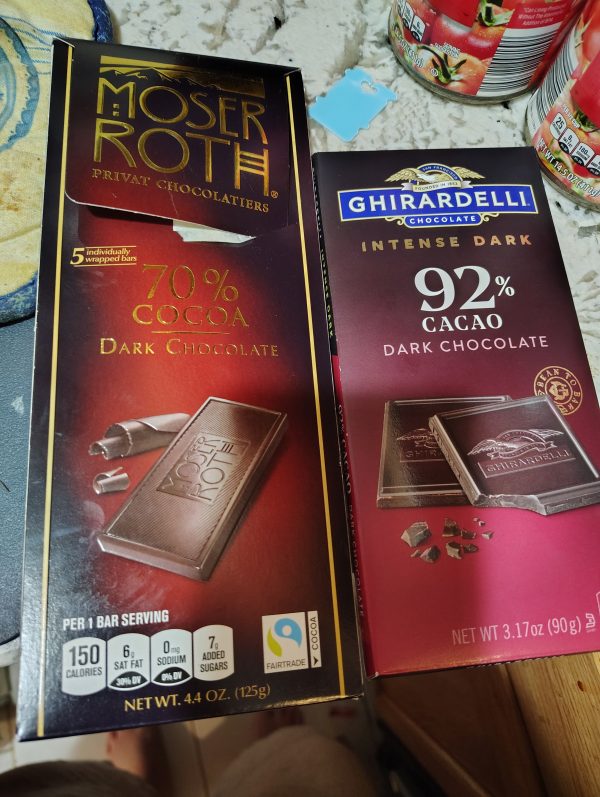
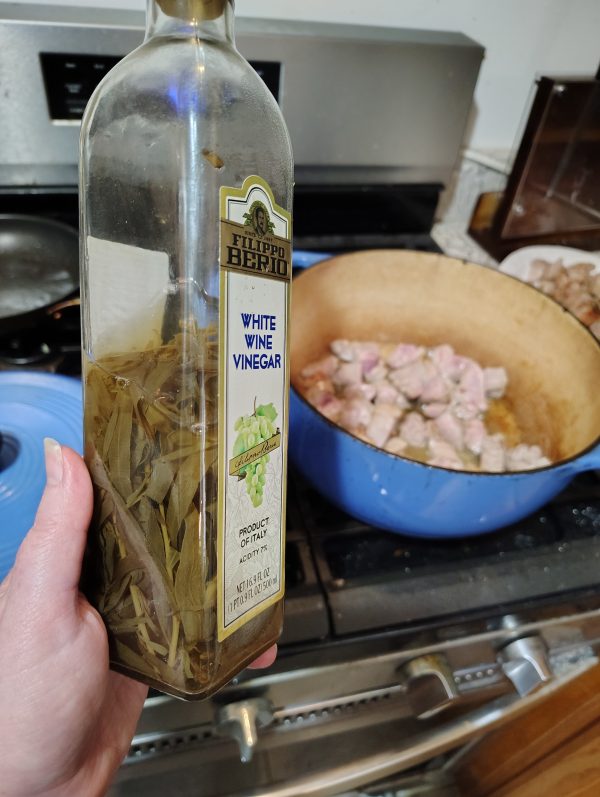
It was June before I could make any actual movement on the cooking. I would have preferred to use whole coriander and had to settle for ground because the first time I thought I was ready to start, I’d run out and forgotten to restock. When heading out to do the errands that would have included the stop at the specialty market for more, my car threw a fit that required turning around and limiting my shopping to a more local store. Meanwhile, The pork shoulder had sat in my fridge for over a week because I’d caught another infection (sinus this time) and I underestimated the impact it would have on my week (which involved burning a bunch of sick time while being in denial that I was actually that sick). The chocolate was about half “Moser Roth” 70% dark (Aldi being a reliable source of fairly good quality chocolate on the cheap) and half Ghiridelli 92% “Intense Dark” (not cheap, but possessing a fruity complexity that the higher test Alsi chocolate and similarly high test Lindt available here seem to lack). The chili powder was urfa biber, which has been sitting in my stash for a few years, bought with the intent to make homemade harissa, another abandoned project idea. The tarragon vinegar was leftover from the first time I made the dish, the wilted leaves I’d stuffed in the bottle looking not the most appetizing but apparently not having suffered in quality from being lost in the back of my cupboard. The long cooking was done in the oven for a few reasons. One, because I now actually have an oven that’s reasonably reliable for holding an accurate temperature. Two because when it’s in the oven the bottom won’t scorch. Three, the next day I was leaving on a long weekend trip and I wasn’t willing to delay the cooking any longer and when, in some desperation, I tried an AI assistant2 as a desperate cry of “help me figure out how to find the time to actually get this cooking done”, it did throw up an actually useful suggestion to check my oven for the”delayed start” function.
Since then, I’ve been reading the book Four Thousand Weeks: Time Management for Mortals. It has a lot to say about how we struggle in vain against the finality of time and our lifespans, regardless of our position on the socioeconomic ladder, fed by influences both cultural and personal to try and cram ever more in. There is a lot for me to mull over still; it’s more a philosophical book than one of easy-fix practical solutions. Acceptance of limits doesn’t come easy to someone raised in the milieu of “you can be anything you want to be, do anything you want to do with enough effort”…and on the other hand, I’ve already had recent experience with accepting limitations which let me stop blaming myself for constantly attempting the impossible.
In any case, I got the dish made. And it’s good. But it’s also weird. Chiles and chocolate might draw comparisons to Mexican mole but the tarragon and the juniper knock it firmly out of that territory and the vinegar gives it much more acidity than just the tomatoes would. Peter mentioned having adapted the recipe from a roast in order to make it less fussy (permit me some skepticism as cutting a roast into cubes and having to brown them in batches is not a small feat). I would be curious to find out more about where the original recipe came from. The combination of ingredients defies any regional category that I’m aware of. Is this turning into a metaphor for who Peter was? I leave that judgment to those that knew him better.
Pratchett famously wrote that no man is dead while is name is still spoken. I’ve thought, in the past few weeks as the remaining scheduled posts have trickled out, that no one on Tumbler is truly dead until their post queue is empty, till the echoes of their reblogs have faded from the internet. But as I write this, the scheduled post queue, having lingered for the last month as a remnant ghost in the machine, seems to have finally run out. Only the reblogs and memories are left. Was Peter happy with the four thousand weeks (give or take) of life he got? I’d like to think so. It sucks that they got cut off the way they did and I don’t envy Diane the grieving process ahead of her knowing my turn will come eventually (for it we escape it ourselves, it probably means we met our own untimely demise sooner than expected).
In the meantime, imagine me raising a mug of tea to honor the both of you, one absent, one remaining. GNU Peter Morwood.
-
I had to put in the Pratchett reference somewhere. However, I am not Death, nor am I playing them on the Internet.↩︎
-
I’m opposed to gennerative AI as a replacement for human creators and human oversight, and I don’t think much of the companies that are making them—I made a point of seeking out one that made several privacy promises before giving it any input. But I’m coming around to their potential utility in an organizational assistant role, particularly in areas where I struggle by myself. The important thing to remember is not to trust them blindly; contrary to some claims, critical thinking is still very much required. It’s like talking to a person both in the good ways and the bad ones.↩︎
 themindstream.net